Locations





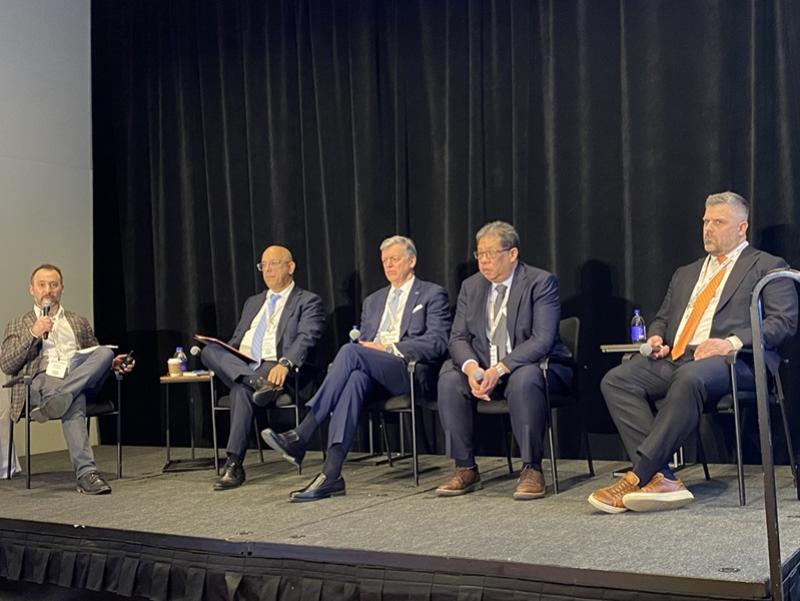
Five real estate industry experts provided insights into what’s happening in Canada’s office, multiunit residential, industrial and retail markets as part of the Feb. 24 RealCapital conference at the Metro Toronto Convention Centre.
Panel moderator and JLL director of Canadian research Scott Figler kicked things off with a slide presentation to give context for what was to come.
“As we’ve dealt with the impacts of rising tariffs and geopolitical uncertainty, employment has been falling across every major Canadian metro, generally speaking, with the exception of Edmonton,” he said.
Public sector job cuts and the effect on private sector positions which rely on the federal government have contributed to making Ottawa the country's worst-performing region.
Investment volumes slid for the third straight year across Canada, decreasing by about three per cent overall, mostly due to falling industrial and land sales.
Multifamily had the highest level of activity at $10.7 billion, followed by industrial at $10.6 billion, land at $8.2 billion, retail at $6.7 billion, office at $5.3 billion, alternative assets at $4.3 billion and hotels at $1.4 billion.
Office
Office availability is steadily declining and just 1.75 million square feet of new supply is expected nationwide by 2029. Office vacancy is declining in Toronto, Edmonton, Winnipeg and Halifax – which has the lowest vacancy rate in North America at 9.8 per cent – while other markets are lagging.
A big discrepancy exists between class-AAA office assets and class-A, -B and -C buildings where vacancy rates are often well into double digits.
Office fundamentals have improved, institutional capital is returning and Desjardins Global Asset Management vice-president and head of real estate investments Richard Dansereau would like to see capitalization rates continue to compress.
Two Desjardins funds acquired a 210,000-square-foot office building at 70 York St. in Toronto from a KingSett Capital fund in November for $134.6 million, prompting Dansereau to note there’s “no better office market than the financial district in Toronto.”
Concerns about artificial intelligence eliminating human jobs and reducing office space needs have caused stock prices of some real estate companies to fluctuate recently. But BGO head of Canada research and portfolio manager Phil Stone believes it’s too early to know how things will play out: “You can't help but be sort of optimistic and then super scared at the same time of what may be ahead.”
Multiunit residential
For the first time since the Canada Mortgage and Housing Corporation (CMHC) started collecting data, more purpose-built rental apartments are under construction than condominiums or single-family homes, driven mainly by CMHC financing.
Canada needs more housing and construction costs have come down but, as other high costs still exist and residential rents are falling across most of the country, it’s not financially feasible for many developers to build. That's especially true at the lower end of the spectrum, where the need is greatest.
“Many builders have high input costs, high land costs and high interest costs, which were unexpected, along with slower absorption,” said Nick Pantieras, senior managing director of investments for Institutional Property Advisors, a division of Marcus & Millichap.
“The math doesn't work out, so many transactions just don't happen.”
“When you look at how Statistics Canada defines construction starts, they’re overstating the supply coming up, so it's even more dire than what we're seeing,” Altus Group VP of data solutions client delivery Ray Wong said.
“If we're going to solve the problem, it's going to require a lot more than what we've been seeing from government agencies and entities, whether it's municipal, provincial or federal,” Dansereau added.
Stone believes there are opportunities to generate midrise, wood-frame multifamily dwellings that can be built faster and more economically than taller concrete structures.
Industrial
Industrial vacancy plateaued in Q4 2025, ending a three-year rise. The amount of new supply normalizing to historical levels after a building boom earlier in the decade should provide stabilization.
Calgary and Edmonton have the lowest industrial vacancy rates while markets that have been more impacted by United States-imposed tariffs, particularly southwestern Ontario and Montreal, saw significant vacancy increases.
“What we're seeing is a bid-ask spread that’s very tough to underwrite in a market where rents are coming down from their peak,” Dansereau said. He noted that Desjardins is actively looking for industrial product in Western Canada.
Pantieras thinks the end of industrial rent drops has arrived and we’re going to start seeing growth again.
Wong doesn’t foresee a more robust recovery until later this year or early next year, as there’s still some uncertainty even if the almost 40 million square feet of leasing activity last year far exceeded 2024’s numbers.
“I agree with Ray,” Dansereau said. “Let's not underestimate the (U.S. President Donald) Trump card that could also have an impact on industrial in particular.”
Stone has been encouraged by the performance of core industrial assets in the GTA and noted tenants are looking to lock up lease extensions well ahead of expiry.
Retail
While time ran out before the panel could discuss retail, Figler pointed out vacancy in enclosed malls jumped from 2.7 per cent to 7.5 per cent and overall retail vacancy rose 80 basis points to 2.4 per cent last year.
That was pretty much exclusively due to the closure of Hudson’s Bay Company’s large stores, he said.




 Industry Events
 Locations