
 Locations



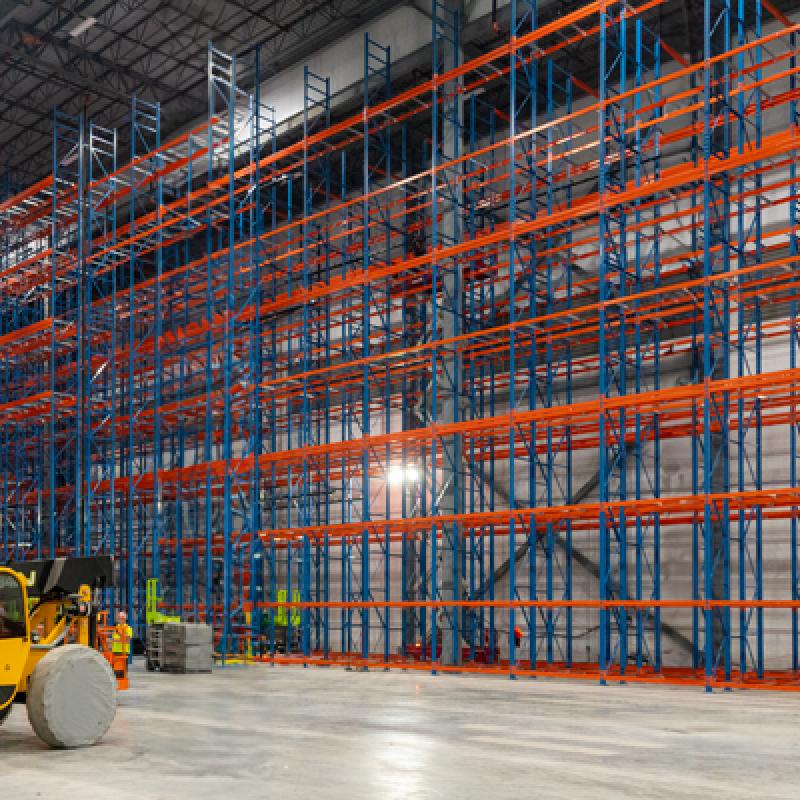
In the recent "golden era" of industrial real estate—the post-pandemic boom of 2021 and 2022—the strategy for occupiers was simple: land-grab as much square footage as possible.
Efficiency was a secondary concern to sheer volume. However, as we navigate 2026, the narrative has shifted. With interest rates stabilized but still relatively high, and capital expenditures under intense scrutiny, the industrial sector is entering the era of the "Agile Warehouse."
In this new environment, the value of a building is no longer just its location or its loading docks. Instead, value is increasingly tied to the flexibility of its internal infrastructure—specifically, its pallet racking system. For landlords, developers, and brokers, understanding that racking is a liquid asset rather than a static fixture is becoming one of the new keys to driving North American industrial ROI.
The death of the "single-user" mentality
Historically, racking was often the last thing considered in a real estate transaction, if at all, and was usually left to the tenant to figure out post-lease. But as "demisability"—the ability to split a large warehouse into smaller units—becomes a primary strategy for landlords looking to mitigate vacancy risk, racking design must be part of the initial conversation.
An agile warehouse utilizes racking systems that are modular, adaptable, and professionally engineered. We are seeing a shift away from specialized, highly customized configurations that only serve one specific SKU type. Instead, institutional owners are favoring designs that can easily transition from standard selective racking to Very Narrow Aisle (VNA) or even integrate with semi-automated shuttles without requiring a total teardown.
When a building is designed with "rack-agnostic" slab specs and fire suppression, it becomes an "evergreen" asset. If Tenant A moves out, the infrastructure is such that Tenant B can move in and be operational in weeks, not months. In a market where "speed to air" (the time it takes to get products into the rack) is a competitive advantage, the agility of the racking system is a primary selling point.
The sublease factor and exit velocity
The Canadian industrial market has seen a notable uptick in sublease availability. When a tenant needs to exit a lease early, the racking system often becomes a point of contention. Does it stay or does it go?
Buildings equipped with high-quality, certified, and flexible racking systems have significantly higher "exit velocity." A sub-tenant is far more likely to take over a space if they can inherit a system that is already compliant with the latest Ontario Building Code (OBC) or National Building Code (NBC) standards. Conversely, a space filled with "zombie racking"—old, uncertified, or oddly configured steel—becomes a liability that can stall a deal for months.
By advising clients to invest in flexible, high-spec racking from the outset, brokers are positioning themselves as high-value partners in the long-term success of their client’s business.
Racking as an ESG pillar
We cannot discuss industrial real estate in 2026 without addressing ESG (Environmental, Social, and Governance) mandates. Most ESG conversations in the warehouse space revolve around LED lighting, EV charging, and carbon-neutral concrete. However, the "circularity" of the warehouse interior is the next frontier.
Steel production is a carbon-intensive process. An agile racking strategy focuses on the longevity and repurposability of the steel. High-quality systems that can be reconfigured, expanded, or moved to a new facility without being scrapped contribute significantly to a firm’s Scope 3 emissions reductions. For institutional landlords, being able to report that their tenant improvements (including racking) follow a circular lifecycle is becoming a vital part of their annual sustainability reports.
The 40-foot challenge
As developers push the boundaries of clear heights, moving from 32’ and 36’ to 40’ or even 50’ in some urban infill projects, the racking is no longer a "storage accessory", it is the building’s skeletal system. The “back bone” of the warehouse, in a sense.
A 40-foot clear warehouse with a standard racking approach is a missed opportunity. To truly capture the value of that "cube," owners must understand the synergy between the slab, the rack, and the material handling equipment (MHE). An agile approach here means designing for future automation or semi-automation. Even if a tenant isn't ready for full robotics today, the racking should be installed with the tolerances and engineered to allow for an easy transition to automated storage and retrieval systems (AS/RS) tomorrow.
Conclusion: From "box" to "platform"
The most successful players in the industrial space are no longer viewing warehouses as "dumb boxes." They view them as sophisticated platforms for distribution.
As we have explored in previous discussions regarding the 2025 Building Code changes and the importance of floor slabs, the physical constraints of a building are set in stone (or concrete). However, the racking is the fluid element. By prioritizing flexibility, compliance, and modularity, stakeholders can ensure their assets remain competitive regardless of how the macro-economy shifts.
In 2026, the question for industrial owners is no longer "How much space do I have?" but "How quickly can my space adapt?" The answer, more often than not, is found in the steel.
If you are looking to explore expertly designed, engineered, and manufactured racking options for your facility—whether it is a new build or a complex reconfiguration—contact North American Steel to ensure your infrastructure is built for the future.



 Industry Events
 Locations