
 Locations




For years, urban agriculture and landscape enhancement programs in commercial real estate were justified primarily through reputation. ESG alignment. Reporting requirements. Responsible stewardship.
Today, their most tangible impact is showing up somewhere far more immediate: tenant retention.
Across office, mixed-use, and institutional portfolios, outdoor spaces are no longer peripheral amenities. They are increasingly experienced as extensions of the workplace itself, shaping how tenants feel about a property day to day and influencing whether they choose to stay.
As occupier expectations evolve, landscape programs are shifting from sustainability signals to strategic tools that support engagement, satisfaction, and long-term asset competitiveness.
Turning existing green space into a tenant engagement lever
Property owners and employers alike are under pressure to bring people back to offices that now compete with the comfort and autonomy of home. Spaces must support focus, connection, and visibly demonstrate investment in employee experience.
When designed with intent, outdoor environments become part of that value proposition:
- Rooftop gardens that offer genuine respite during the workday
- Pollinator gardens that create moments of pause and connection
- Harvesting gardens that tangibly express ownership’s commitment to place
In this context, green space stops being decorative. It becomes a differentiator in return-to-office conversations and a measurable contributor to tenant satisfaction.
Why execution determines impact
As landscape enhancements take on a more direct role in occupier experience, execution becomes decisive.
Programs that are poorly maintained, disconnected from daily operations, or inadequately communicated to tenants quickly lose credibility. In some cases, they introduce new friction rather than value.
By contrast, initiatives designed within an integrated property management framework, where landscape strategy aligns with ongoing operations, remain relevant and effective over time.
At scale, in practice
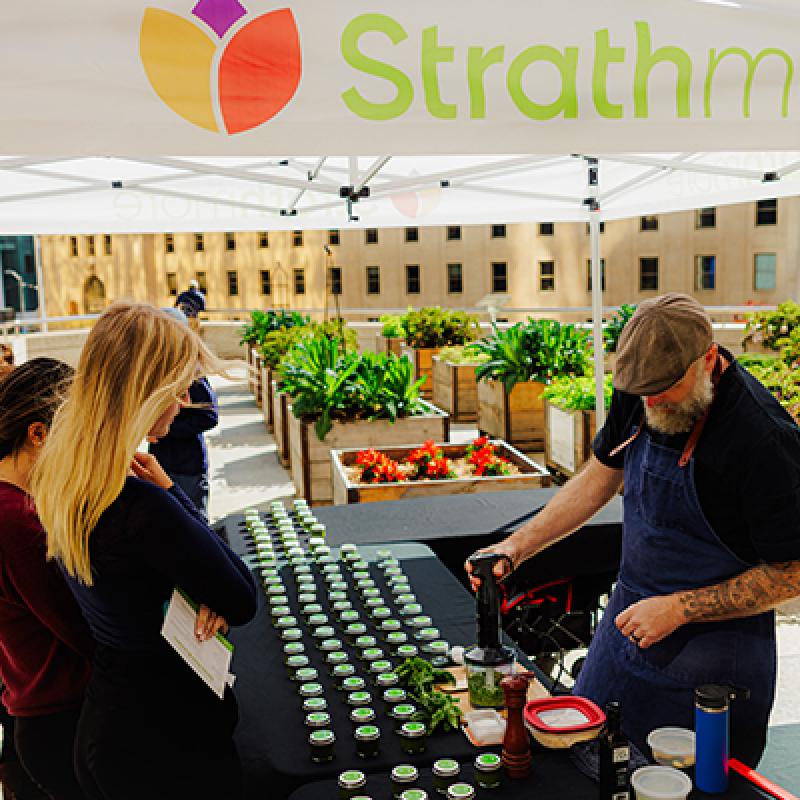
Strathmore has delivered a series of tenant-facing landscape initiatives in partnership with Colliers, designed to encourage engagement without adding operational complexity for property teams.
Post-event survey data across these programs revealed consistent outcomes:
- Increased tenant awareness of ownership’s investment in the property
- Strong appreciation for outdoor spaces as part of the workday experience
- Qualitative feedback linking landscape engagement to improved workplace perception
This work has since been recognized with industry awards for landscape innovation and tenant engagement, reinforcing that the impact is both experiential and professionally measurable.
Why this matters to decision-makers now
Landscape enhancements are no longer evaluated solely on ESG merit. They are increasingly assessed on whether they contribute to how a property performs in everyday use.
When they do, they become part of what makes an asset easier to defend, easier to position to tenants, and more resilient in a competitive leasing environment.
For property and portfolio managers navigating retention pressure and return-to-office challenges, landscape strategy is one of the few tangible investments that directly influences occupier experience while strengthening long-term asset value.
Learn more about how Strathmore can support your landscape enhancement needs at www.strathmore.pro


 Industry Events
 Locations