Locations






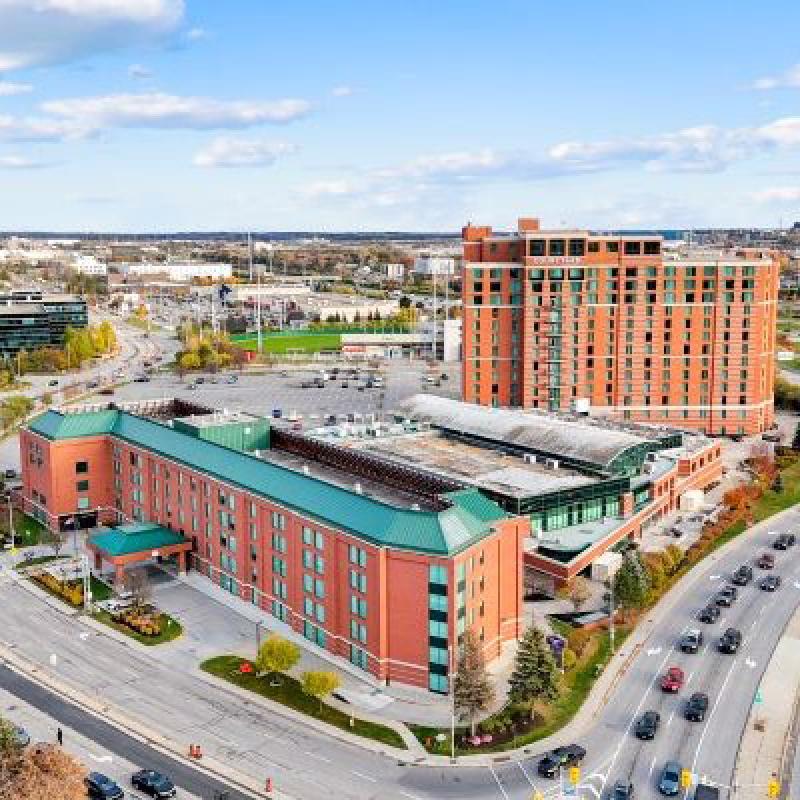
With 21 years of navigating hospitality investments from hotels and restaurants to related asset classes, Jessi Carrier has seen the Canadian market through multiple cycles.
As Senior Vice President at Colliers Hotels, he tracks where capital is flowing, what's driving pricing, and determines which fundamentals matter when the headlines become noisy. In this conversation, Jessi breaks down the current state of Canada's hotel investment landscape and what investors should be watching as we head into 2026.
How would you characterize the current state of Canada's hotel investment market? Are we seeing strong fundamentals, or are there underlying challenges investors should be aware of?
The market is firing on both cylinders—operationally and from a liquidity standpoint.
Despite occupancy dips in some markets tied to manufacturing or border dynamics, national RevPAR is up just over 5% year-over-year. U.S. demand has softened, but domestic travel and tourists from outside the continent have more than picked up the slack. Canadian tourism had a record-breaking summer, bringing in nearly $60 billion in revenue. We expect that momentum to carry into 2026.
On the capital side, both debt and equity remain abundant. Schedule A banks and Tier 2 lenders like credit unions are actively deploying capital, and recent consolidations—HSBC with RBC, CWB with National Bank—have only strengthened their capacity. Existing owners are sitting on strong cash positions, and new investors are drawn to hotel returns relative to other asset classes. Through the third quarter, we've seen $1.9 billion in transaction volume, driven by marquee deals in major markets and steady mid-market activity across Ontario, Alberta, Quebec, and the Maritimes.
Hotel pricing has been a hot topic lately. Are we seeing genuine value appreciation in Canadian hotel assets, or is limited inventory driving up prices? How sustainable is the current pricing environment?
It's genuine appreciation, not just scarcity pushing numbers up.
Three factors are at work. First, operating fundamentals are improving, which lifts profitability and asset values. Second, construction costs are reshaping the market. When it costs over $200,000 per key to build a limited-service hotel in a secondary market, existing assets naturally command higher prices. Those elevated costs are also steering investors toward acquiring and renovating older properties rather than taking on the risk and regulatory complexity of ground-up development.
Third, strong liquidity—both debt and equity—combined with solid operating trends, has heightened competition for quality assets. Nationally, the average price per key hit $230,000 through the third quarter, up 50% year-over-year. That's partly due to major trades above the $50 million and $100 million marks, but we're seeing price growth across all segments, from limited to full service.
Which regions across Canada are attracting the most investor interest right now, and what's driving those preferences? Are we seeing any notable geographic shifts in investment patterns?
Ontario remains the dominant player, especially Toronto, for large-scale deals. Secondary markets like Kitchener-Waterloo, Ottawa West, and northern Ontario—Sudbury, Thunder Bay, and North Bay—continue to attract strong interest thanks to historically solid fundamentals.
But limited inventory in Ontario is pushing investors to look elsewhere. Calgary, Greater Montreal, Quebec City, Halifax, and other Atlantic markets are seeing increased attention as buyers chase availability and higher yields.
We're seeing some hotel transactions that seem to involve significant real estate components beyond just the hospitality business. Are investors increasingly viewing hotels as mixed-use real estate plays?
Absolutely. Land scarcity in prime markets and rising construction costs are driving this shift.
The reasoning is straightforward. Increase profitability per square foot by incorporating residential, retail, or office space alongside the hotel. Projects that combine different uses also help manage the increasingly complex zoning and approval procedures. They make debt financing easier because diversified income streams appeal to lenders, and they attract investors seeking to mitigate risk in a challenging development environment.
Given the current economic environment—interest rate concerns, inflation pressures, and global uncertainty—what's your outlook for hotel transaction volume through the beginning of 2026?
Despite some geopolitical and economic uncertainty, the outlook is positive.
Operating fundamentals remain strong, even with a few market-specific slowdowns. Capital is available, and interest rates are coming down, which is good for deal flow. Canada's stability continues to attract foreign investors looking to diversify, and we have a strong base of domestic owners with capital to deploy. We're expecting a healthy transaction pipeline into 2026, with several high-profile hotels on the market and a solid mix of limited-service properties in secondary and tertiary markets.
Remote work is slowly decreasing. How will the return to in-person work change business travel? How are investors adapting their strategies, particularly for business-oriented hotels and conference facilities?
Corporate travel is rebounding. Meetings and conventions are back—convention centers in Toronto, Vancouver, and Montreal are reporting positive growth. As return-to-office policies take hold, we expect business travel to increase further, driven by the need for in-person collaboration and culture-building. There are simply parts of business that must be done face-to-face, and that will fuel demand for hotel rooms in major business hubs.
That said, rising airfare costs, reduced flight availability, and inflationary pressures on travel expenses warrant close monitoring. Without new investments in transportation infrastructure to enhance accessibility and affordability, businesses may struggle to justify the cost of extensive travel. Investors need to keep that front of mind when evaluating business-oriented hotels and conference venues.
Looking ahead five years, what fundamental shifts do you anticipate will reshape the Canadian hotel investment landscape? What should investors be preparing for that might not yet be on their radar?
Institutional capital is taking hotels more seriously. Groups that once stayed on the sidelines now see hotels as a core part of diversified real estate strategies. At the same time, private groups are scaling portfolios in secondary and tertiary markets, benefiting from new transit links, infrastructure projects, and regional tourism growth.
We're also seeing capital move across provinces as investors build scale and balance exposure—mixing urban and regional assets to capture different demand drivers across the country.
On the consumer side, preferences are shifting toward experiential and lifestyle-driven stays, fueling the growth of mixed-use urban developments. We're seeing conversions of well-located offices and other asset classes into hotels. It's a reflection of how the sector adapts to both market realities and evolving traveller expectations.
But there's a regulatory piece that can't be ignored. Governments at all levels need to modernize the environment and make it easier to invest, build, and do business in Canada. Streamlining those processes will be key to keeping capital flowing.
Ultimately, investors who consider beyond traditional urban assets and align with emerging growth areas will be best positioned for the future.
Please visit our Quarterly and Annual Hotel Investment Reports page for more information.





 Industry Events
 Locations