Locations



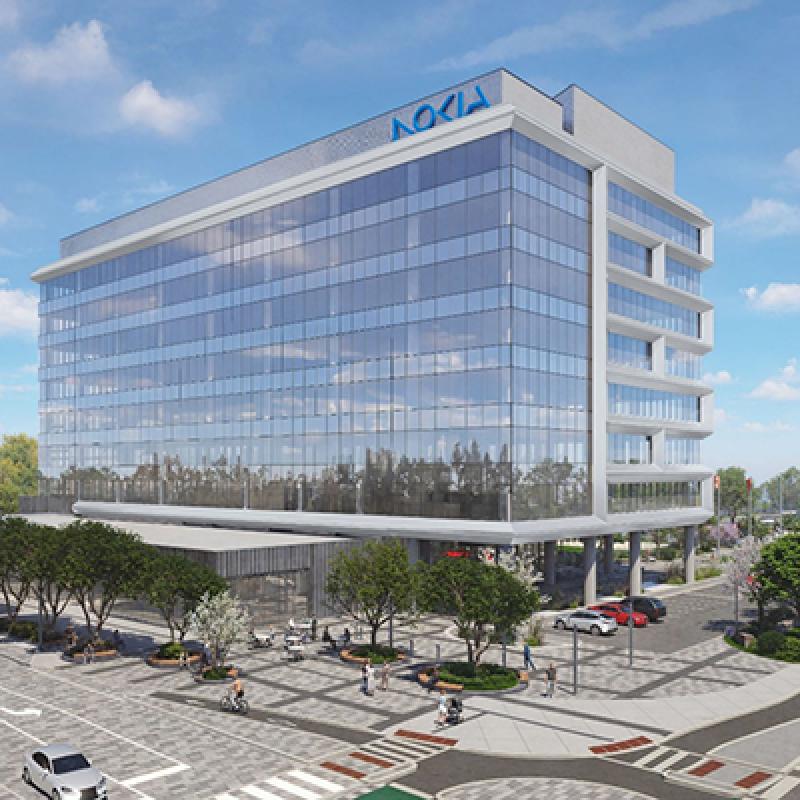
Nokia’s Ottawa Innovation Campus redevelopment represents one of the most significant real estate projects undertaken in Canada in recent years.
The 750,000-SF mixed-use R&D campus brings together multiple laboratory research environments, collaborative work places, and community amenities to support Nokia’s people and next-generation technologies. The project strengthens Canada’s digital infrastructure while advancing leadership in AI, quantum technologies, and future network development. Colliers Strategy & Consulting played a central role in shaping the project – from early strategic advisory through to capital structuring, government engagement, and execution.
From strategic vision to national innovation anchor
The origin of the project can be traced back to Nokia’s long-term strategic goal of modernizing and expanding its Canadian R&D presence. The partnership with federal, provincial, and municipal governments is strengthening digital infrastructure while accelerating advances in AI and quantum technologies.
The new campus further strengthens Nokia as a key anchor in the Kanata North Innovation District and the largest single employer in the Ottawa telecom cluster, reinforcing the region’s role as a global innovation hub.
Recognizing the complexity of a redevelopment of this scale, Nokia engaged the Colliers Strategy & Consulting team to explore strategic pathways across its landholdings, workplace requirements, transaction options and optimal capital funding structure. This early-stage advisory work established the foundation for a highly coordinated and future-focused development strategy.
Delivering a landmark transaction with national economic impact
This redevelopment represents one of the most consequential real estate and innovation-infrastructure transactions undertaken in Canada. At its core, there is a 750,000-SF mixed-use R&D and workplace campus, supported by approximately CAD $430 million capital raised through a private placement, contributing to a total capital value of CAD $750 million.
The economic impact is significant. The project will create more than 300 new roles tied directly to R&D expansion, while also enhancing co-op opportunities for Canadian post-secondary students. Government participation further underscores the project’s importance, with more than CAD $70 million in financial support enabled through Colliers’ business cases.
From an industry perspective, the transaction stands out for its innovative capital structure. By leveraging a credit-tenant-lease (CTL) financing model, the project secured long-term, fixed-rate funding aligned with Nokia’s corporate credit, rather than being constrained by the asset’s suburban location or specialized R&D use. This approach successfully overcame conditions that would traditionally deter institutional investors.
Overcoming market, capital, and planning complexity
Delivering the project required navigating multiple layers of adversity, including financial, market-driven, regulatory, and planning factors.
Capital availability. The specialized R&D focus, combined with a sub-market location from a traditional investor perspective and a split credit rating, constrained conventional financing options. Many equity investors required premium yields that did not align with Nokia’s financial parameters, necessitating a shift toward non-traditional financing solutions.
Market conditions. Construction cost escalation, labour and material inflation, and rising investor yield expectations introduced volatility into both development budgets and investor appetite. In response, Nokia and Colliers continuously refined financial models, evaluated alternative scenarios, and implemented value-engineering measures, while preserving core R&D program requirements.
Planning complexity. The project required navigating zoning amendments, land severance, and cost-sharing arrangements with neighbouring property owners and the City of Ottawa. Through expert analysis, strategic recommendations, and hands-on support in negotiations, Colliers helped streamline approvals, optimize land use, and establish fair cost-sharing structures that minimized risk.
Pioneering financing and a new model for innovation districts
Innovation is at the core of both the development vision and the capital financing structure.
The campus itself represents a pioneering R&D environment, integrating 450,000 SF of laboratory space with 300,000 SF of modern workplace and community amenities. This reflects trends that prioritize experiential, collaborative, and talent-focused environments.
Equally innovative is the capital structure. The credit-tenant-lease (CTL) structure allowed Nokia to access CAD $430 million in capital at favourable, long-term fixed rates. This mechanism remains underutilized in Canada. Colliers and Nokia worked closely to negotiate and customize the CTL framework to ensure alignment with the project’s business case and market conditions.
The collaboration between Nokia, Colliers, and multiple levels of government represents an innovative model – aligning economic development, global technology leadership, and long-term real estate value creation.
This integration of public and private stakeholders, combined with advanced financing and development strategies, establishes a forward-looking blueprint for innovation-district development in Canada.




 Industry Events
 Locations