Locations






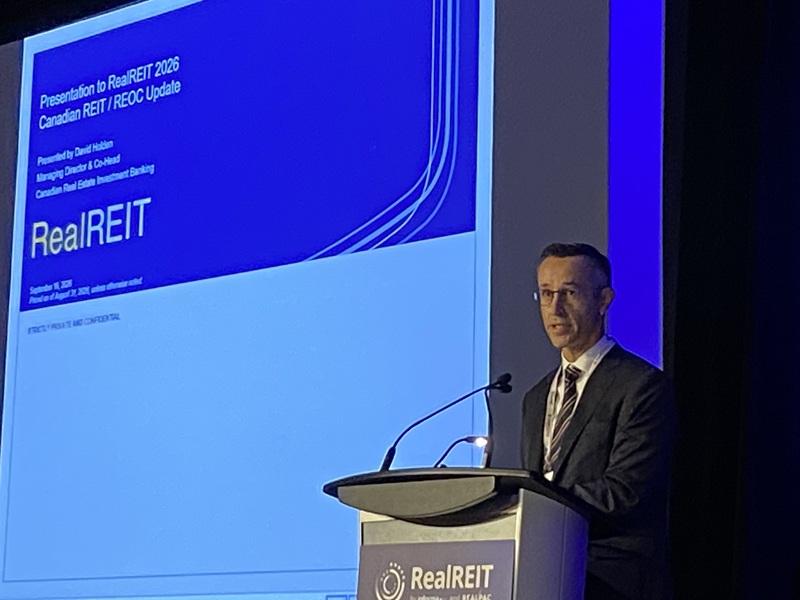
The Canadian aggregate real estate investment trust market cap remained unchanged at $76 billion since last year’s RealREIT conference, RBC Capital Markets Real Estate Group managing director and co-head of Canadian real estate investment banking David Holden revealed at this year’s Sept. 16 event at the Metro Toronto Convention Centre.
Holden’s presentation on 12-month Canadian REIT performance was based on valuations on Aug. 31 for 2025 and 2026. He pointed out that the record high REIT market cap is $101 billion, which still pales in comparison to the current $1.6-trillion REIT market cap in the United States.
“While the stand-alone REIT market cap was unchanged, we did see growth across a number of sub-sectors of the REIT market,” Holden continued. “However, it was offset by a number of REIT privatizations, most notably in the multi-residential sector, where we lost Dream Residential REIT, European Residential REIT, InterRent REIT and Minto Apartment REIT — an aggregate loss of $3.5 billion of contribution to the prior year's equity market capitalization.”
Retail is the largest asset class for Canadian REITs, accounting for 46 per cent (up three per cent from a year earlier), followed by seniors housing at 17 per cent (up seven per cent) and residential at 15 per cent (down seven per cent).
New issuance activity over the past 12 months has been approximately $2 billion, which contributed to some growth in the market cap. That number was up materially from 2023 and 2024’s year-end totals and 2026 is on pace to fall about $300 million short of 2025’s $2.3-billion total.
Activity remained modest compared to historical averages, however, and was largely focused in the seniors housing sector. There were no initial public offerings in the Canadian REIT market in the last 12 months.
Other performance indicators
Improvements in Canadian REIT leverage were seen in industrial and seniors' housing, while leverage moved higher in office, residential and diversified REITs. Retail remained unchanged.
“The liquidity ratio today, as measured by cash plus available credit lines as a percentage of total debt, is a very healthy 16 per cent — down marginally from 17 per cent last year, but near the high end going back to 2009,” said Holden.
Sixteen Canadian REITs raised their distributions and one made a cut over the past 12 months, which compares to 20 increases and one decrease over the previous 12 months. The weighted average yield at the end of August was 4.7 per cent, which is 20 basis points inside of last year's average.
Canadian REITs delivered a price return in the last 12 months of minus one per cent, which was offset by distributions to deliver a total return of four per cent. That compares to a price performance of minus three per cent and a total return of four per cent over the previous 12 months.
“Looking at TSX REIT performance by property type, seniors' housing was once again the standard, delivering a 47 per cent return after delivering a 34 per cent return in the comparable period last year,” said Holden.
“Retail and industrial followed with healthy returns of 17 per cent while diversified, residential and office all delivered negative returns.”
Globally, U.S. REITs delivered a 16 per cent return, while European REITs were aligned with Canada at four per cent and Asian REITs took a one per cent loss.
Mergers and acquisitions
Mergers and acquisitions (M&A) have picked up considerably as private markets continue to value real estate at a premium compared to the public markets, as REITs are trading at a discount to net asset value (NAV).
There have been six M&A deals over the past 12 months. Several of them have been related party transactions where the acquirer of the target or a member of the acquiring group is an insider of the target and/or has a meaningful equity or debt interest in the target.
“The insiders saw the lack of support for their business in the public markets and they still had conviction on the real estate's long-term potential,” Holden explained.
“So they took action to acquire these portfolios at premiums to public market values, but clearly at a price where they saw the opportunity to earn a healthy return over their hold period.”
Two more entities are also in play to be acquired: Slate Grocery REIT and Plaza Retail REIT.
“We've seen a number of REITs look to allocate capital to buy back their units, owing to the steep discount (to NAV),” said Holden. “Year to date, we've seen the most activity in the residential, industrial and retail sectors.”



 Industry Events
 Locations