
 Locations





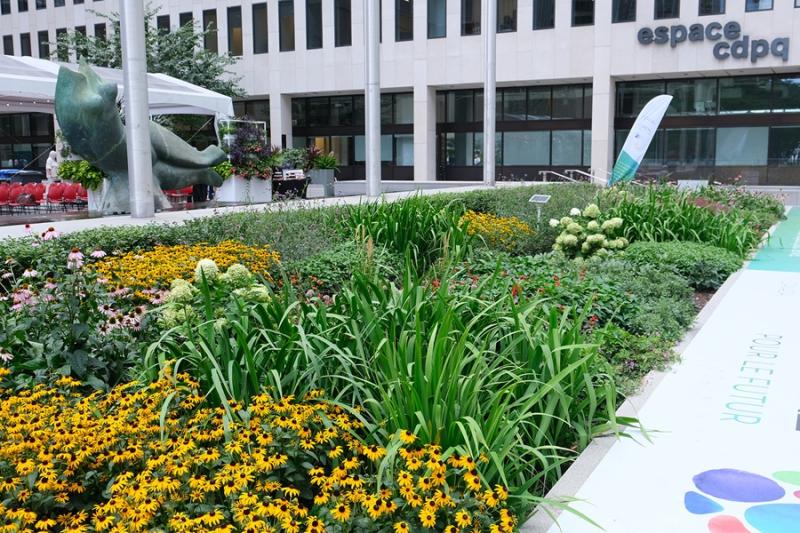
When L'Oréal Canada first proposed creating a pollinator garden at Place Ville Marie, the objective was straightforward: bring more biodiversity into the heart of downtown Montreal.
Working alongside Canderel, Strathmore and the Montreal Insectarium Espace pour la Vie, that vision became a 700-square-foot pollinator garden in 2025.
Just one year later, it has expanded into a 3,000-square-foot landscape woven throughout Place Ville Marie's esplanade — transforming one of downtown Montreal's busiest public spaces into a living part of the property.
But the most interesting outcome has had very little to do with pollinators. It has changed the way people experience the property.
During leasing tours, prospective tenants stop to ask about the gardens. Employees eat lunch there. Visitors linger. The space has become a talking point — not because someone installed new landscaping, but because it represents something tenants increasingly look for when choosing where they want to work.
That shift says something much larger about commercial real estate. The exterior environment is no longer simply part of a property's appearance. It has become part of its value proposition.
The leasing conversation has changed
Office buildings have traditionally competed on location, floorplates, amenities and the quality of their interior spaces.
Today, Canderel is seeing another factor enter the conversation. "When we're touring prospective tenants through the property, they notice the gardens," says Julie Vocelle, Canderel's client relations coordinator.
"People stop and ask questions. It creates conversations we weren't having a few years ago. They can picture their employees using the space differently."
Those conversations rarely stay focused on plants.
They quickly become conversations about employee wellbeing, workplace culture and the kind of environment organizations want to associate themselves with.
For companies evaluating office space, the building itself has become part of their employer brand. That is a significant shift.
Rather than simply leasing square footage, landlords are increasingly offering an experience that helps tenants attract and retain talent.
At Place Ville Marie, that experience now starts before people even walk through the front doors. The gardens contribute to a shared ambition for Place Ville Marie: to create an inviting, warm and human campus where people feel good at work and a genuine sense of community can take root.
Employees wanted this
The project also began differently than many sustainability initiatives. Instead of deciding internally what environmental project to pursue, L'Oréal Canada asked employees.
Several ideas were presented — including medicinal gardens and planting species used in the company's products — but one option received overwhelming support. The pollinator garden.
"We wanted people to feel part of the project from the very beginning," says Karine Gagné, campus director, L'Oréal Canada.
"When employees help shape something, they care about it differently. The gardens became theirs before they were ever planted."
That ownership mattered later.
Native pollinator gardens don't always resemble the ornamental flowerbeds people expect. Some plants are taller. Others appear less manicured. Because employees understood why those choices were made, the gardens generated curiosity rather than complaints.
The project became something people talked about with pride. The project has attracted attention well beyond Canada. As one of the first initiatives of its kind within L'Oréal globally, it has become a reference point for other markets exploring how biodiversity can be integrated into the workplace.
Teams from around the world have looked to Montreal as an example of what meaningful collaboration between L'Oréal, Canderel and Strathmore can achieve.
A living building
One of the recurring themes from both Canderel and L'Oréal was that the project never really finished. Each season has introduced another opportunity. The gardens expanded.
The partners are now exploring edible gardens and additional biodiversity initiatives. That evolution also supports Place Ville Marie's broader certification strategy, embedding biodiversity more deeply into the property's environmental performance — and demonstrating what becomes possible when a property owner, tenant and landscape partner work toward a shared environmental ambition.
That ongoing evolution reflects a broader lesson. Successful outdoor spaces are not static capital projects. They behave more like living systems.
They require stewardship, collaboration and a willingness to adapt. Perhaps that is why both organizations offered similar advice to others considering a comparable initiative.
Don't approach it as a certification exercise. Approach it because you genuinely believe it will make the place better.
As Pierre-Luc Gravel, marketing director, property management at Canderel, puts it: "If you're doing it as a checklist, people will feel that. You have to care about it. That's what creates engagement."
More than landscaping
Commercial real estate has spent decades investing in the workplace experience inside the building. Lounges became hospitality spaces. Lobbies became destinations. Fitness centres, cafés and tenant programming became competitive advantages.
What Place Ville Marie demonstrates is that the next frontier may be outside. The gardens contribute to biodiversity, reduce urban heat and support environmental certifications. Those benefits are real and measurable.
But the larger value lies elsewhere. They give prospective tenants another reason to choose the building. They give employees another reason to come into the office. They create moments of conversation, discovery and community in a part of the property that was once simply passed through.
For landlords competing to attract the next generation of tenants, that may be one of the most valuable investments they can make.



 Industry Events
 Locations