
 Locations





NEW COLUMNIST: In the wake of COVID-19, a six-storey office podium mid-construction in downtown Toronto effectively lost its entire market value almost overnight.
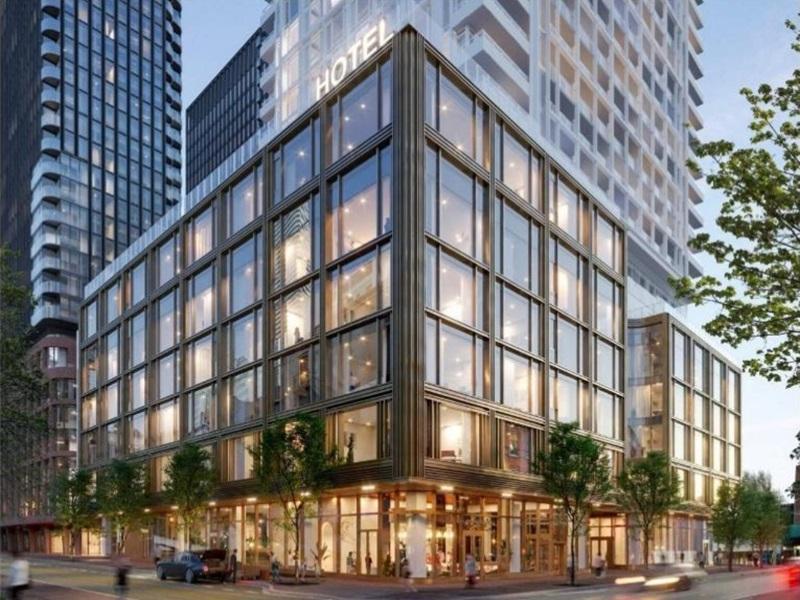
The 108,000-sq.-ft. commercial component of 80 Queen St. East, designed by Hariri Pontarini Architects for St. Thomas Developments, had been conceived as a built-to-sell office campus intended for a large corporation (i.e. - a Google), and the architectural design reflected that ambition; expansive oversized glazing and generous floorplates suited to open-work concept, with a dedicated lobby and street presence befitting of a sector leader.
Then the office market stalled.
Finding prospects to lease office space during the uncertain times of the pandemic was difficult enough - finding buyers proved impossible. Marketing the building as a single campus failed. Subsequent attempts to parcel the floors failed. Multi-tenant strata office scenarios failed.
It was clear a pivot would be required, but the concrete had been poured.
Sales for the 51-storey condominium residential tower above the commercial podium progressed successfully, but that component had also exhausted the site's allowable residential GFA - precluding any option to extend residential into the podium. Even if a variance for additional residential could be argued with the city - the inefficiencies of the deep floorplate and the costly rework required to convert the envelope’s inoperable glazing eroded any feasibility.
Institutional and educational prospects were explored but posed practical challenges with no natural opportunity for tiered assembly space or the fixed core that conflicted with their expected vertical transportation demands.
The pro forma no longer worked and there was no obvious pivot, all while construction continued on site.
Designing a repurposing….
The eventual solution of a hotel was nearly dismissed out of hand.
The superstructure of the 51-storey tower met the podium in ways that constrained optimized suite planning. The deep office floorplates weren't a natural fit for double-loaded guestroom corridors. While the inoperable windows were well suited to hotel-use, the oversized glazing, and similarly the mullion and structural grids, had been designed for open office tenancy - not compartmentalizing standardized suites… and with on-going construction, the window of opportunity for architectural intervention was ever-closing.
While the use-case for hotel was not obvious, when studied through a performance lens rather than a typological one, efficiencies and design opportunities to unlock value could be found.
The depth of the office plate, initially perceived as a liability, became an operational advantage. The back-of-house operational functions required for a hotel typology (housekeeping, linen storage, administrative support etc.) could be appropriately programmed to the interior of the plates, fully preserving the perimeter glazing for revenue-generating suites.
By strategically introducing “donut” corridor circulation, the suite yield could increase without triggering dead-end egress conditions.
Intentionally oversized curtain pockets were introduced to mask the jogged demising needed to navigate the mismatched mullion and structural spacing. This avoided compromising optimum room sizing and appearance from street level without altering the facade.
Corner suites were carefully configured to increase key count while maintaining viable room dimensions.
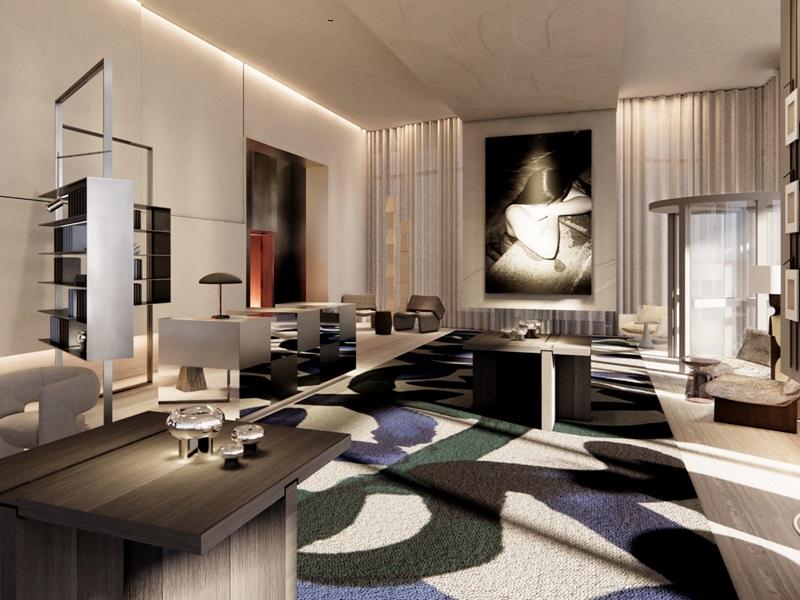
At ground, the office lobby and adjoining commercial retail unit were consolidated and reimagined as a hospitality arrival sequence.
Strategic considerations included: Expanding capacity for washrooms suitable for food and beverage offering and substituting the incoming revolving doors with automatic entry, better suited to the flow of luggage-carrying guests.
Below grade, the office parking allocation was recalibrated for hospitality demand. The office service areas and parking scheme were redesigned to allow for valet services and much needed back-of-house hotel support spaces.
A new, viable design
These were not cosmetic adjustments. They were repurposing tools, shifting perception from “commercial strata office” to “destination hospitality.”
After an intense period of design studies, a viable hotel layout emerged - initially accommodating approximately 120 hotel suites. That number alone materially changed the conversation. The asset was now viably reconceived as an income-producing hospitality asset.
From there, the exercise became one of controlled optimization. Through iterative studies, the suite count evolved…. 120 keys grew to 150, to 170 and even at one point reaching 180. The final scheme settled at 164 suites - not because more couldn’t physically fit, but because potential risk of delivery began to outweigh marginal revenue gain.
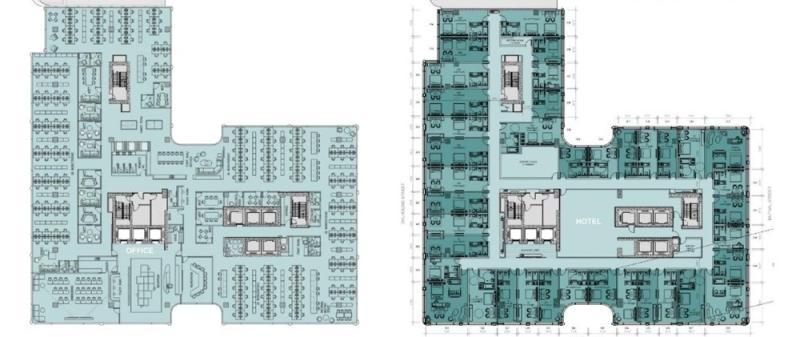
Comparison of the original office layout, left, versus the repurposed hotel layout. (Courtesy Hariri Pontarini Architects)
Sometimes the most consequential design moves are invisible
Re-purposing conversions often fail financially because of slab intervention. If each hotel suite were to have four drains (sink/shower/toilet/kitchenette), at 164 suites those costs quickly compound. At 80 Queen, the concrete structure was already in place and the sensitive zones of structural rebar imposed strict limits on new penetration locations.
Suites had to be planned around strategically consolidated and stacked plumbing locations to minimize slab penetrations and retrofit cost exposure. What could have become cascading change-orders was resolved through disciplined alignment to rationalized service cores. In re-purposing, maximization often doesn’t define performance, risk-adjusted optimization does.
Performance outcome
The repurposing effort managed to drastically expand the buyer pool at a time the office market was spiralling. The result was a revenue density profile competitive with purpose-built hotel product - within a building never intended for that use.
President of Hotels, Sandeep Gupta of Sunray Group, the eventual purchaser, previously told RENX: “Because of the way the office podium was set up, we were able to gain a lot more suites in the hotel than a general downtown hotel would provide.”
The asset, once stranded, successfully sold for an undisclosed price in December 2025. No additional GFA was added. No structural overhaul was required. No envelope redesign was undertaken.
Just a rigorous study of the built condition, its latent efficiencies and identifying design opportunities to recapture its value.
The take-away
When market conditions invalidate an asset’s intended program, the first instinct is often financial restructuring.
But before revising the capital stack, it is worth revisiting the design strategy. At 80 Queen, the constraints were real: exhausted GFA, an unyielding core and shell, ongoing construction and a shifting market. Yet within those limits, the building still contained tremendous value.
In repurposing commercial real estate, design is critical to performance. When the market shifts, the built form remains. The question becomes can the design be reinterpreted to align with new demand.


 Industry Events
 Locations