Locations






Canada's banks could increase their office space leasing by up to 1.5 million square feet during 2026, according to a prediction by Oxford Properties' Kevin Hardy during the Real Estate Forum in Toronto.
“What we're going to experience in Q4 of this year and Q1 of next year is probably the biggest and fastest take-up of space I've seen in 20-plus years in Toronto,” said Hardy, who is Oxford's vice-president and head of eastern Canada office.
“I think the banks alone will take down a million to a million-and-a-half square feet of net new absorption in Toronto.”
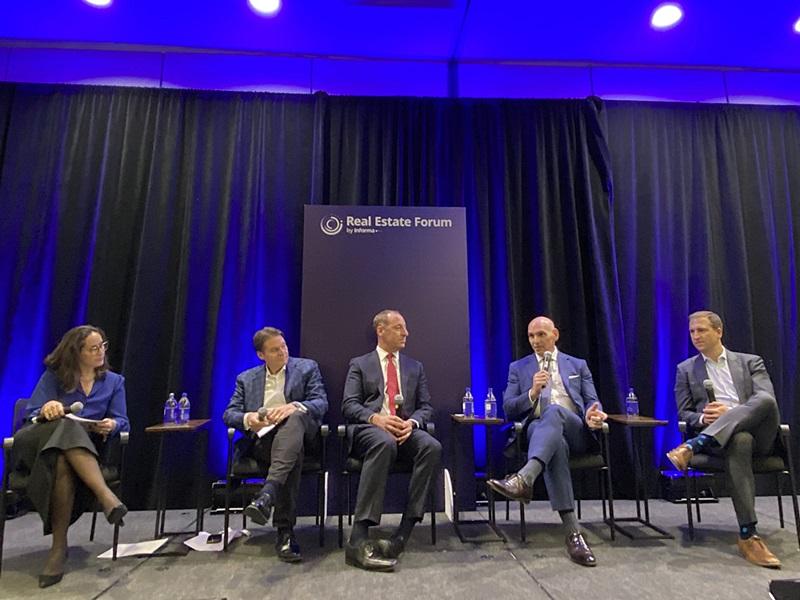
He was speaking during a panel discussion moderated by Savills president for Canada Ruth Fischer during the Real Estate Forum on Dec. 4 at the Metro Toronto Convention Centre. Participants presented insider perspectives on the office market in 2026 and beyond.
Hardy's prediction would be more welcome news within the sector, where Canada’s higher-end office buildings have been leading a market recovery this year. Older and less well-located and amenitized buildings, however, are still experiencing high vacancy rates.
GWL Realty Advisors executive vice-president of portfolio management Steven Marino noted that industry-wide office valuations were down 25 per cent in Canada and 43 per cent in the United States over the past three years.
More office space will be needed
However, Marino said more investors are now more actively exploring adding office buildings to their portfolios as they see momentum growing and seek to take advantage of that lower pricing.
“The office has a pivotal role in companies creating talent and achieving their strategy and goals,” said EY transaction real estate leader Zach Pendley, an advocate of banks now mandating that their employees be in the office four or five days a week.
“In Canada, the five big banks and the government occupy almost a quarter of all of our office space. So having the conviction of the government and the banks saying 'we're in the office' sends a really strong message to investors and landlords who have been waiting for that kind of bold move to demonstrate that the office is here to stay.”
Pendley agreed that banks are looking at their office space needs for the next five to 10 years and realizing they don’t have enough of it — and there’s little available to lease in the best buildings.
When considering that, as well as the spillover needs of other companies that depend on banks, he thinks a pro forma for a new office development could soon work — though maybe not in 2026.
The importance of amenities
Aspen Properties president and chief executive officer Greg Guatto said Calgary had a 10-year head start on Toronto in dealing with high office vacancy rates. Its downtown core had as much as 14 million square feet of empty space, which forced building owners to look at how to differentiate their properties.
The bare minimum a building can offer is a gym and a conference room, according to Guatto, who keeps track of space utilization data to show tenants how and when their employees are using space. Aspen has prioritized amenities, programming and management to the point where Guatto said it feels like they’re in the hospitality business.
“The type of space, service and amenities that customers need has changed forever, and I think that's for the better,” Hardy added. “Calgary and Vancouver were way ahead of us (Toronto) in terms of building out assets to serve customers much more progressively.
“I think Toronto was the victim of its own success. We were full and getting incredible rents and we didn't need to amenitize because we didn't have the space to do it. I think that’s changing now.”
Having a high-quality, well-located site with good public transit connections and walkability is still the best amenity that can be offered, according to Pendley.
“Things that allow for easy connectivity, collaboration space, great food and beverage options within the building, or building-adjacent, are what drive most tenant decisions,” Pendley said. “The rest, like the game rooms and entertainment zones, I question whether those are truly driving value in buildings.”
“We want to do everything we can to keep our tenants in our buildings, but there has to be an economic relationship that works,” Marino added. “We're making long-term investments of capital and we're trying to forecast where the market's going and what the needs of those tenants are long-term.”
Lease terms and flexibility
Tenants have always preferred shorter lease terms while landlords have always wanted longer contracts. Today, however, Hardy said longer terms are needed by both parties in order to finance tenant build-outs that can cost from $200 to $500 per square foot in class-A buildings.
Class-B and -C building owners trying to minimize their capital expenditures still have to offer shorter lease terms and incentives to attract and retain tenants.
“Coming out of a softer set of market conditions has given tenants more flexibility and the right to be more flexible, and landlords and owners have been able to rationalize that,” Marino said.
“But I think when this pendulum swings and there's a more balanced market in many of our environments, owners are going to start to query how much duration they need to ultimately allow in order to give themselves the ability to do other things within their portfolio.”
Measuring office performance
Hardy said his company uses vacancy rates to measure its portfolio and its competitiveness, but has stopped relying on them when looking at a particular market.
“We need to know what the competitive set of any specific asset is, not a market vacancy,” Hardy explained. “So whatever the vacancy in Toronto is doesn't mean much to me. It's one of the six or seven assets that I compete with for this particular number that makes sense to me.”
Marino likes to look at the yield of his company’s office assets to get a read on their success and viability because it tells you what your cash flow is, gives a representation of value and allows you to better understand financeability.
Guatto monitors ancillary income from parking, retail, restaurants, bars and event spaces that may occupy a mixed-use building along with office space in order to get a stronger handle on overall performance.



 Industry Events
 Locations