Locations








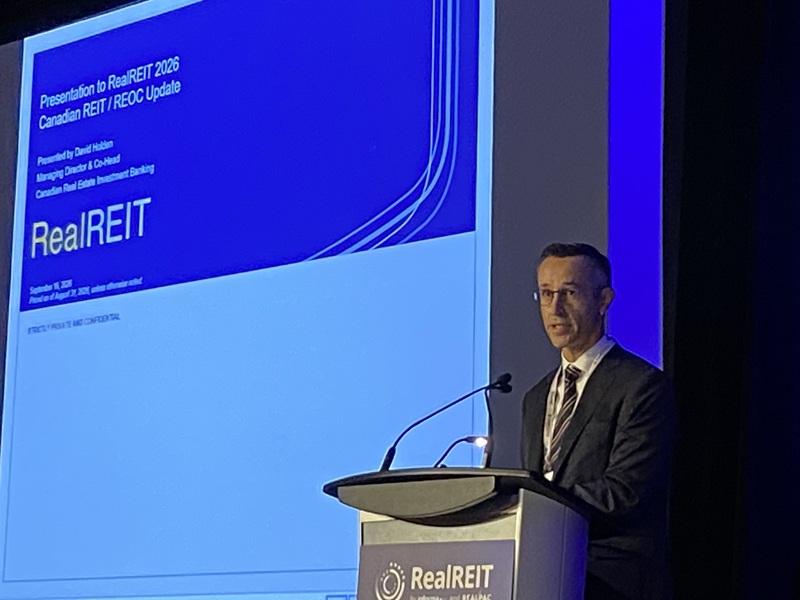
Investment seems to be moving away from real estate, and a panel discussion moderated by Real Property Association of Canada (REALPAC) CEO Michael Brooks at the Sept. 16 RealREIT conference at the Metro Toronto Convention Centre examined where capital is being allocated and how real estate investment trusts can attract more of it.
“I think the two are not substitutes for each other, I think they're complements for each other,” said Lora Gotcheva, an independent board member of SmartStop Self Storage and the former managing director and portfolio manager at CPP Investments, about the differences between public and private real estate.
“They provide access to different sub-sectors, different geographies, different leverage structures, different liquidity structures, different fee structures and, very importantly, they're priced differently at a given point in time. I think investors are best served to have the flexibility to invest in both.”
Energy and infrastructure investments are delivering good returns, offer inflation hedging, and they’re durable and long-term. That has made them primary real asset competitors to real estate in major pension fund portfolios.
Real estate has been weaker in recent years
“Historically, the case for real estate really centred on consistent total returns, a meaningful income component, inflation hedging and diversification,” said Gotcheva. “All of these are so important but, if you look at the last several years, absolute returns for real estate and relative returns for real estate have been weak.”
“Think back to the early 2000s when institutions started investing in real estate,” said BGO managing partner and Canadian chief investment officer Simon Holmes. “It was to provide some kind of moderate premium over fixed income.
“That dynamic has totally changed now that we have real estate in these real asset pockets and programs. They’re competing for those scarce investment dollars versus sectors such as private equity, infrastructure and even private credit, which have delivered returns well into the double digits.”
Holmes said the past four years have been the most painful for the Canadian commercial real estate industry since the early 1990s. But he’s confident the situation will turn around because real estate is undervalued and will one day again present compelling risk-adjusted returns that we’re not seeing today.
More alternative options in the United States
Alternative asset classes such as data centres, self-storage and cellular towers are much more widespread in the United States than in Canada, which gives investors more choices than the four traditional real estate classes that still dominate the Canadian REIT market.
“A lot of these are unproven and haven’t been through a full cycle the way the four major property types of real estate have,” said Holmes of these newer asset classes, which he thinks could be at risk of being over-allocated.
“I think it's a story that's unfolding in real time and will be told in the coming years.”
Seniors housing is coming on strong
Some might still see seniors housing as an alternative asset class, but its success over the past three years after emerging from the COVID-19 crisis has moved it closer to the mainstream — if it’s not there already.
Chartwell Retirement Residences chief investment officer and chief legal officer Jonathan Boulakia said seniors housing should be “a core investment that any serious real estate investor should include in their portfolio.”
Boulakia explained that demographic tailwinds and supply not keeping up with demand, which is expected to remain the case for the next 15 to 20 years, are fuelling major interest in seniors housing by institutional investors.
“People now understand what we offer, and I think investors and consumers are looking for differentiated operators who have operating excellence as their value proposition,” Boulakia continued.
Primaris leads among retail REITs
Brooks pointed out that the second-quarter results for the MSCI/REALPAC Canadian Property Index showed that residential and industrial were the worst performing asset classes after being the top performers just a few years ago.
Retail was the top performer in the most recent index, and Primaris REIT is the current frontrunner in its field as it continues to make acquisitions and deliver market-leading returns as Canada’s only enclosed shopping centre-focused trust.
“In pretty much all of the acquisitions Primaris had done, it was the only buyer at the table, which allowed the company to capitalize on some incredible opportunities,” said chief investment officer Julian Schonfeldt, who joined the trust after leaving Canadian Apartment Properties REIT earlier this year.
Primaris announced a $200-million equity offering on Sept. 14 to fund future acquisitions and for general trust purposes. It’s in various stages of negotiations on potential acquisitions with an aggregate potential purchase price of more than $1 billion.
“I think management is as important as the portfolio or asset class because a bad management team can ruin almost any asset class and then, conversely, a really strong management team can turn a tough portfolio or a tough asset class into something special,” said Schonfeldt.
“Smart investors aren’t going to be as focused on a discounted premium to NAV (net asset value), but more focused on the strategy, the company, the management team and a record of growth and discipline,” added Boulakia.
Growing the Canadian REIT market
Brooks said some Canadian REITs don’t have enough trading volume to attract institutional capital, and that can also make it difficult to get in and out of a trust without having a major impact on its stock price.
“Being investor-friendly is what's going to ultimately bring capital into the REIT space and allow us to trade higher and bring more IPOs (initial public offerings),” said Schonfeldt.
While IPOs have been few and far between in recent years, Holmes expects to see them within the next five years as people start viewing REITs more favourably again.
“I think it's under-appreciated how difficult it is to get the attention of a global REIT fund manager, let alone a global diversified equity fund manager,” said Gotcheva. “Canada is 2 per cent of the global benchmark while Welltower is 8 per cent.
“So if you're a fund manager, you know it’s four times more important to get Welltower right than the entire Canadian market. And it’s a lot less work.
“Canadian REITs need to give investors a reason to pay attention, and that can be a compelling cycle or structural growth opportunity. It can be very strong management and great capital allocation, which ultimately leads to compounding capital for share growth, because that's what investors care about.”




 Industry Events
 Locations