Locations



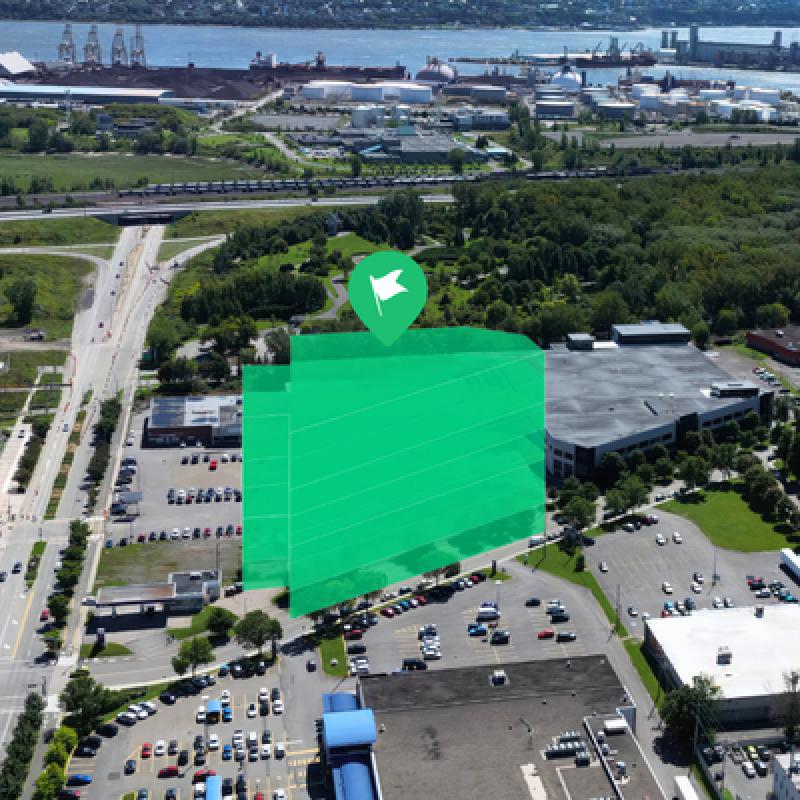
In Quebec's land market, roughly 70% of transactions happen off-market — a figure drawn from Landerz's own transaction monitoring, which tracks land deals across the province.
That number defines the challenge facing every developer, housing organization, or corporate team looking to grow: the most relevant opportunities are invisible by default, buried in a fragmented and opaque market that rewards persistence and relationships over analysis.
What the market has long needed is a platform combining geospatial intelligence, regulatory data, and a curated inventory of opportunities matched to a buyer's specific thesis. That is precisely what Landerz is building. The results are starting to show.
Landerz was built to change the underlying economics of that problem. Since inception: over $1 billion in land assets listed on the platform, 4,500+ active developers and investors searching for opportunities, average selling price above $3 million per transaction, and 6,000 residential units currently in pre-development across active mandates.
The structural gap in the land data
Land sits at the intersection of more data types than any other asset class: zoning regulations and planning documents, usage constraints — wetlands, floodable zones, contamination — infrastructure access, cadastral and title detail, market comparables, demographic trends, and use-case specific layers from transit proximity to energy potential. None of it has been aggregated, structured, and made current in one place, until now.
Landerz has closed commercial site acquisitions in under 12 weeks. In a market where land transactions typically take six months at minimum — and over a year for strategic sites — that compression is the direct result of having the right data before the first conversation starts.
Built differently — from the data up
Landerz rebuilt the brokerage model from the data up.
A land intelligence layer: Over 50 active data layers and market signals covering the full stack — zoning, planning frameworks, usage constraints, market comparables, ownership and title — feeding three analytical outputs: what can be built on a site, what it's worth, and where the opportunities are. Hundreds of additional layers in integration.
Off-market inventory: Less than 10% of identified sites ever reach the public market. Platform clients access all of them — currently over 1,000 opportunities, with dozens added weekly. Municipal planning documents are monitored in real time to surface sites with arbitrage potential before owners have recognized it themselves.
Execution team: Urbanists, pre-development specialists, and geospatial data engineers alongside brokers. Acquisition mandates are executed with custom filters by region, price, density, zoning, and area. The team contacts owners directly and reserves identified sites for partner clients. 3D modeling, pro formas, and comparables are standard deliverables.
New — AI diagnostic: regulatory analysis in seconds
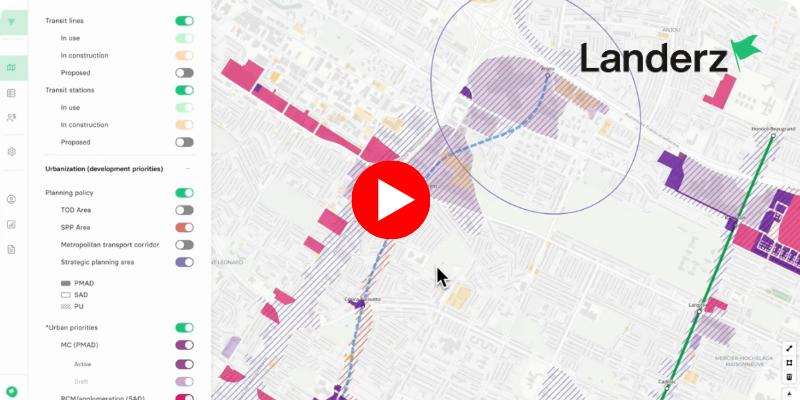
Previewed at the 2026 Montreal Real Estate Forum and now in private beta, Landerz's AI lot analysis tool does in seconds what typically takes two to three weeks: complete regulatory analysis for any site — what can be built, under what conditions, and through what approvals pathway. Input a lot number; the tool consolidates site data, integrates regulatory parameters, determines development potential, and flags material risks upfront. The first conversation with a client starts where due diligence used to end.
The proof is in the deals
Data and technology accelerate the process — but it's the transactions that transform cities, unlock housing, and move the societal and business projects that matter. Across Quebec, Landerz is closing an increasing share of the province's most complex and strategic land mandates.
A $30M heritage redevelopment mandate from the Société québécoise des infrastructures, resulting in an 800-unit residential project for developer Residia. A 137,000 sq. ft. site in Longueuil unlocking 670 units of affordable housing for one of Quebec's largest OBNL projects. A $27M municipal acquisition in Terrebonne that ended a decade of legal dispute and created a 71-hectare nature park. A distressed high-end hotel project in one of Montreal’s most vibrant areas, Plateau-Mont-Royal. And 34 million square feet of ecologically significant wetlands secured for Ducks Unlimited Canada in one of the largest privately initiated conservation transactions in Quebec history.
Landerz has closed commercial site acquisitions in under 12 weeks. In a market where land transactions typically take six months at minimum — and over a year for strategic sites — that compression is the direct result of having the right data before the first conversation starts.
The platform is moving fast. The door is open.
Near-term: hundreds of additional data layers in integration, AI at every transaction step, off-market inventory growing weekly. Landerz is hiring brokers ready to work inside a genuinely different model.
If you are active in Quebec's land market — as a developer, investor, institution, or corporate real estate team — the conversation is open. Explore the platform, request private beta access to our tools, or bring us a mandate.
Land brokerage platform: landerz.ca


 Industry Events
 Locations