
 Locations





GUEST SUBMISSION: A decade ago, an industrial condo sale in the Greater Toronto Area was a rarity – just 17 changed hands across the entire region in 2016, worth a combined $28.5 million. Last year, 374 sold for a combined $937 million.
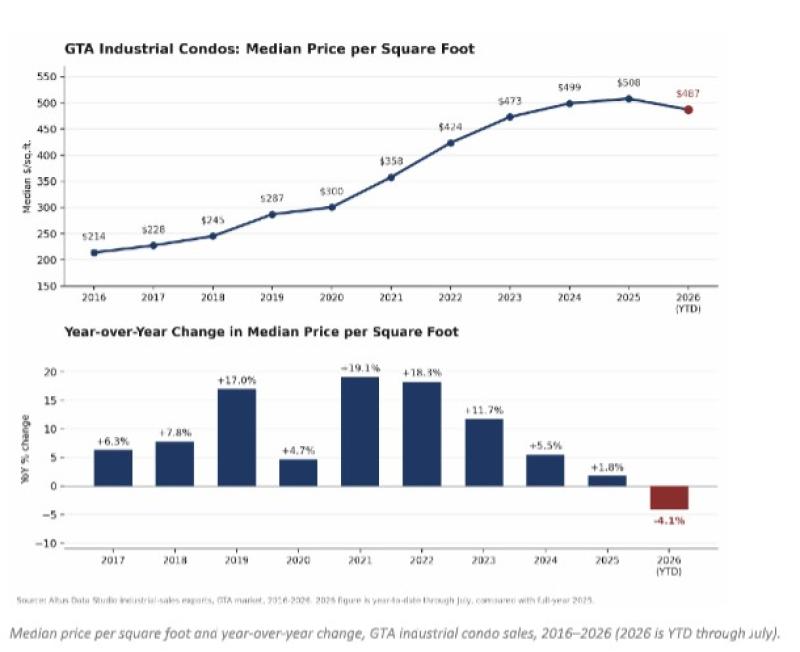
Median price per square foot has climbed from $214 to $508 over that stretch, a compound annual gain of roughly 10 per cent.
What began as a niche play by a handful of developers has become one of the most closely watched corners of GTA industrial real estate.
Now, 2026 may be the year it faces its first real test.
Few developers have watched that shift more closely than Beedie.
Founded in Vancouver in 1954, the company is one of Western Canada's largest industrial developers, with more than 30 million square feet built since then.
The market that grew up
Jorden Dawson, executive vice-president at Beedie and with the company for close to 12 years, has watched its GTA condo program grow from its earliest days.
"The condo market has changed as it's grown. Part of that is just more people becoming comfortable with the overall concept of condo ownership on the industrial side of things," Dawson said.
"When we started out in the GTA, that was a relatively new concept, at least from the standpoint of doing it at the scale we undertook."
Comfort builds over time, Dawson said, pointing to British Columbia, where the concept is established enough that new buyers usually already know someone who owns a unit, and often upsize once they're comfortable, a pattern he expects the GTA to repeat.
“That ownership drive is still very strong in the GTA,” he said.
A decade of growth meets its first plateau
Much of that price growth arrived in bursts rather than a steady climb, then cooled sharply after 2022, as the chart below shows. Through July of this year, the median sits at $487, down slightly from 2025's full-year figure of $508, the first year-over-year dip in the data. It's a partial-year number worth confirming against Q3 and Q4 closings, but paired with deal volume also roughly flat, it reads more like a plateau than a correction so far.
Deal volume has held up better than pricing, growing every year from 2016 through 2025 without a single down year. Annualized, 2026 is on pace for roughly 355 deals and $897 million, essentially flat with 2025 rather than in decline.
Not every developer sees it so evenly. A representative from Berkshire Axis, which has completed more than 30 GTA condo projects over the past decade, said increased supply and decreased demand over the past 18 months has meant location, size and quality now decide which projects sell.
Some areas like Brampton and Vaughan remain strong but others are slower.
That's a useful check on the closed-sale data, which lags what's happening at the offer stage: deals signed today may not close, and show up in the numbers, for months.
Smaller units, built to combine
Median unit size sold has fallen by roughly 45 per cent over the decade, from 6,527 square feet in 2016 to under 3,700 square feet in each of the past three years.
Developers describe that less as a retreat to smaller product and more as a deliberate widening of who the market serves, while keeping the option to combine units for buyers who need more space.
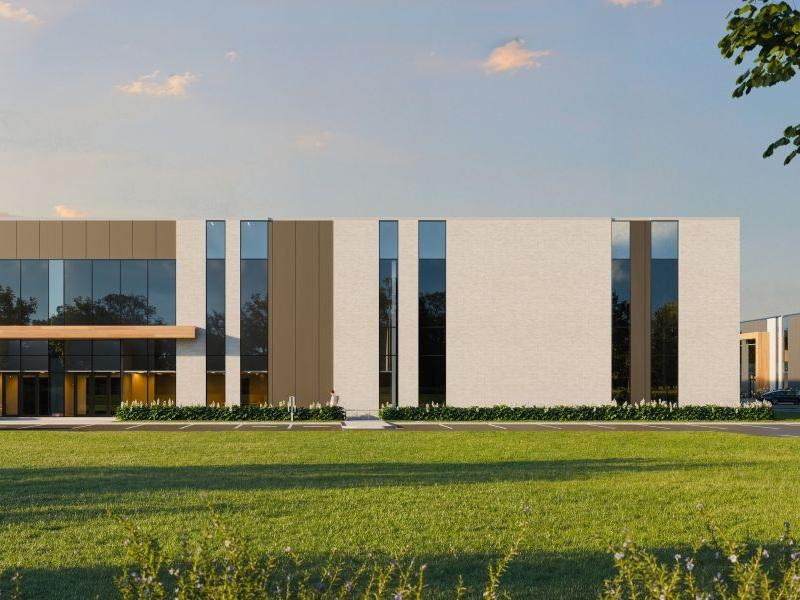
At Beedie's Octave project in Mississauga and BOLT in Bolton, base units “form the core of the program,” Dawson said, but purchasers can combine units to get closer to 20,000 square feet.
GWL Realty Advisors (GWLRA), the institutional asset manager established in 1993 as the real estate arm of insurer Great-West Lifeco, arrived at a similar conclusion.
With $18 billion under management at the end of 2025, more than 30 per cent of it industrial, GWLRA is building its first strata project, Leslie Link, a 120,486-square-foot, 14-unit development in Richmond Hill.
"Our analysis suggests that 50 per cent of the local market is comprised of tenants in the 5,000 to 25,000-square-foot range, with a particular void of options in the 8,000 to 10,000-square-foot segment," said Nikola Parenta, GWLRA director of development.
"Our offering meets that market while also maintaining flexibility for purchasers to combine units to accommodate larger requirements in the 16,000-plus-square-foot segment."
Leslie Link is GWLRA's first foray into strata, not its last. Executive vice-president Steven Marino said the firm believes “comparable opportunities are selectively available across the country,” a sign that institutional capital may be moving from investing in this asset class to building it directly.
An uneven supply pipeline
The share of condo sales involving buildings two years old or newer swung from 6.7 per cent in 2016 to a high of 41.8 per cent in 2023, dropped to 12.6 per cent in 2024, then rebounded to 30.6 per cent last year, a pattern that looks more like two waves of new supply than steady growth.
Dawson points to the GTA's approvals process as the reason: Beedie can move from land acquisition to delivery in under a year in British Columbia, but entitlements alone can take two years here, a lag he expects will keep causing imbalances, much like it already does in the leasing market.
The same dynamic oversupplied GTA big-box industrial development in 2021, when a wave of developers rushed in during peak pandemic demand and delivered right as the market turned.
Beedie's hedge against a repeat – no internal targets tied to maximizing project count. “Quality over quantity,” Dawson said.
Where it's happening
York Region led early on, taking nearly 65 per cent of volume in 2016. That's shifted to Peel, which has led every year since 2020 (31 to 47 per cent share), powered by Brampton and Mississauga, while Toronto proper has resurged since 2023 on infill and redevelopment.
Within Peel, Brampton has overtaken its longtime rival. Condo product there has priced at a premium to Mississauga in each of the last three years, from $562.50 versus $457 per square foot in 2023 up to $554.50 versus $470 in 2025, a reversal of Mississauga's historic address premium.
What's next
The one bottom line across three developers: ownership demand hasn't gone anywhere, even as pricing and location shift underneath it. Dawson's confidence comes from watching this pattern play out over a longer arc in British Columbia.
Berkshire Axis is finding real growth inside a tighter market, with Brampton, Vaughan and Markham as bright spots.
GWLRA is backing the segment's staying power with capital, not just an opinion.
Ultimately, whether 2026's flattening prices are a pause or something more will hinge on how well the GTA's slow approvals process keeps supply in step with demand, a risk Dawson has already flagged.





 Industry Events
 Locations