



 Locations

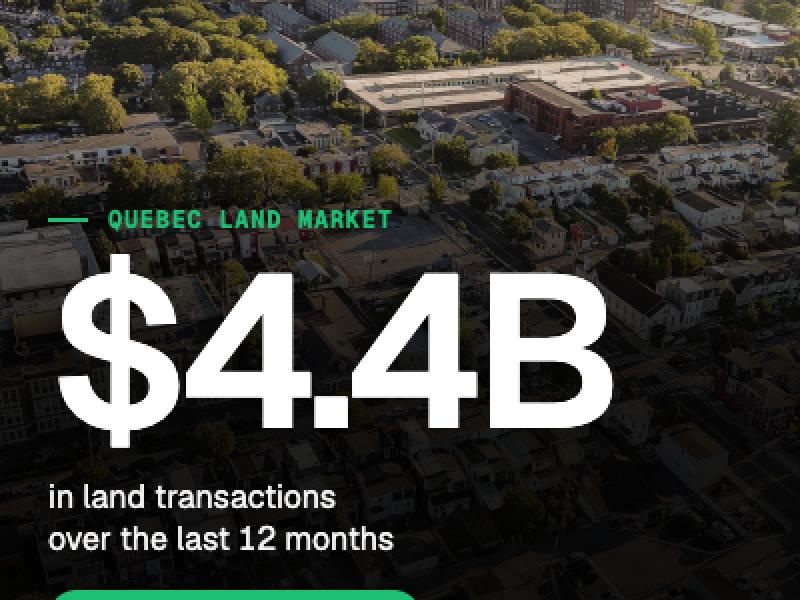


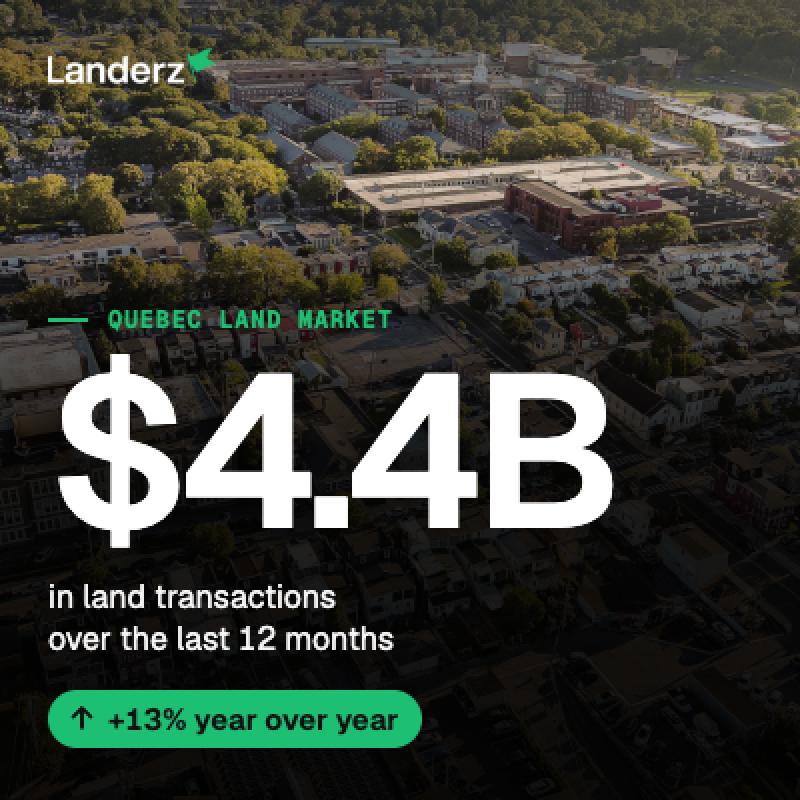
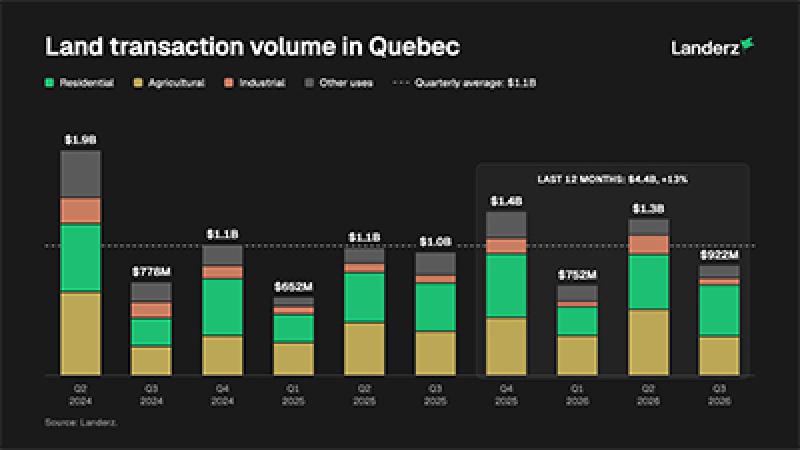
About $4.4 billion worth of land changed hands in Quebec over the past 12 months, up 13 per cent year over year.
Yet the headline figure conceals a changing market. Buyers are more selective, sellers face growing pricing pressure, and the ability to manage development risk increasingly determines what a property is worth.
Landerz's latest analysis, built on its monitoring of all land transactions and development projects in Quebec, points to a market where opportunities remain, but investors need a sharper understanding of demand, costs and timing.
Landerz CEO Simon G. Boyer says it best: "Improvisation is over."
Residential land cools while other segments gain ground
Residential land sales in Greater Montréal fell by nearly a third over the past year.
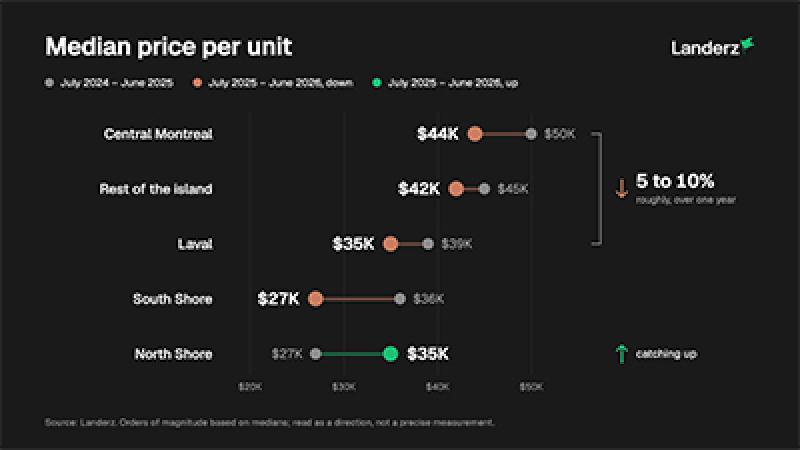
Median price per unit for residential high-rise projects by area, July 2024–June 2025 vs. July 2025–June 2026. Source: Landerz.
Prices declined approximately 5 to 10 per cent per door on the island and in Laval, as buyers revised offers faster than sellers adjusted expectations.
Demand has become more targeted.
- Suburban townhome sites remain attractive to developers serving first-time buyers.
- Smaller residential projects and seniors' residences are also drawing interest.
- Large, multi-phase concrete towers face greater headwinds from financing and construction costs.
Elsewhere, activity has held up.
- Industrial land recorded a 27 per cent increase despite tariff concerns, supported by interest in smaller buildings for local businesses.
- Agricultural land transactions approached residential land activity, with most purchasers being local producers expanding their operations. Cropland prices rose about 10 per cent.
Population, capital and costs weigh on the market
Quebec's population is expected to dip by 2030, with the island of Montréal shrinking while Québec City and the northern suburbs grow.
Immigration policy under the new minority government could move that projection by hundreds of thousands in either direction.
Households will be older either way. All projected population growth through 2040 comes from people 75 and over. The tenant of 2030, Landerz argues, may care less about a 41⁄2 (two-bedroom) near a school than about an elevator.
Capital is the second constraint. Rates have settled higher, and many investors have less appetite for risky projects.
Costs are the third. Construction costs in Montréal rose 8.4 per cent in a year, against 2.3 per cent across Canada, driven by tariffs, scarce labour and new collective agreements. Developers often try to claw that back through a lower land price.
Five trends that could drive new demand
Major projects may open opportunities beyond traditional residential development. Vincent Shirley, Real Estate Strategist at Landerz, outlines five to watch:
- High-speed rail: Alto's proposed Montréal–Laval–Ottawa corridor could influence values near future stations.
- Electricity: Hydro-Québec's transmission expansion may increase the appeal of industrial sites with reliable power access.
- Data centres: A projected fivefold rise in electricity demand from the sector by 2035 could favour large, power-ready sites.
- Defence: Shipbuilding in Lévis and munitions projects in Repentigny and Valleyfield could support surrounding industrial activity.
- Port logistics: The planned Contrecœur container terminal could stimulate warehousing and logistics demand along the South Shore.
These projects will unfold over years, making location and timing critical to investment decisions.
Advice for buyers and sellers in this market
Land values increasingly depend on what buyers can build, when they can build it and how much uncertainty they must absorb.
For sellers: Reduce uncertainty to maximize value.
- Invest in the right studies. Environmental, contamination and geotechnical assessments give buyers confidence.
- Advance regulatory approvals. Zoning changes, municipal agreements and site-specific approvals, such as a PPCMOI, can significantly improve a property's marketability.
- Avoid overplanning. Full architectural plans are expensive and can narrow the pool of buyers.
- Run a competitive sales process. Reaching qualified buyers with a pre-analysed property file will improve pricing and transaction outcomes.
For buyers: Structure deals strategically and understand your market.
- Manage capital and development risk. Consider income-producing properties with redevelopment potential, deferred balances of sale, seller equity participation or purchases conditional on permits.
- Stress-test project economics. Account for higher construction costs, financing uncertainty and exit cap rates. Landerz advises against modelling an exit below 4.5 per cent.
- Know the end customer. Projects designed around a clearly defined market can outperform. Take Aera, a residential development in Chambly targeting affluent baby boomers, which was fully leased before delivery.
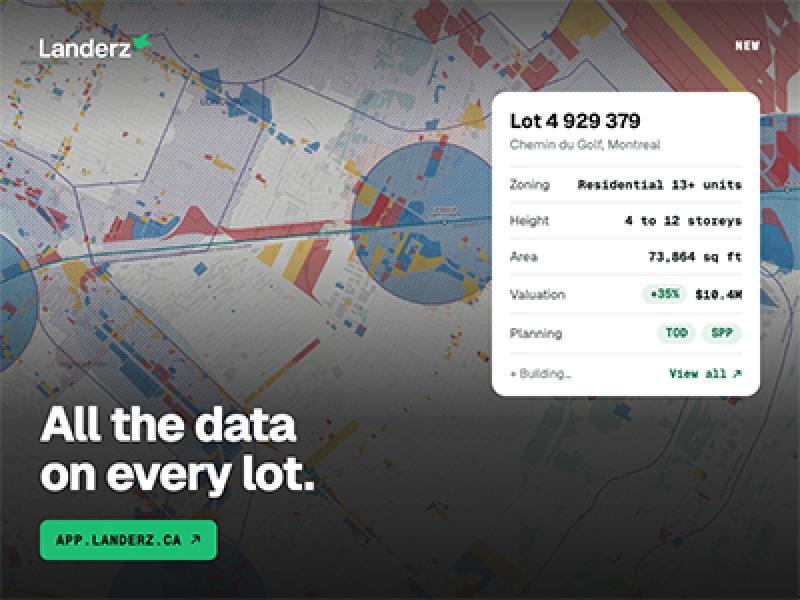
Connect with Landerz. Our data, expertise and technology can help accelerate your real
estate projects.
How Landerz is supporting the industry
Landerz's brokerage and data platform now cover a broader range of strategic assets across Quebec, from multi-residential to industrial and commercial. We're pre-developing more than 10,000 residential units and have expanded our advisory and land entitlement services for developers and property owners.
Our new app, open to the public at app.landerz.ca, gives professionals investment opportunities and exclusive territorial and real estate data.



 Industry Events
 Locations

